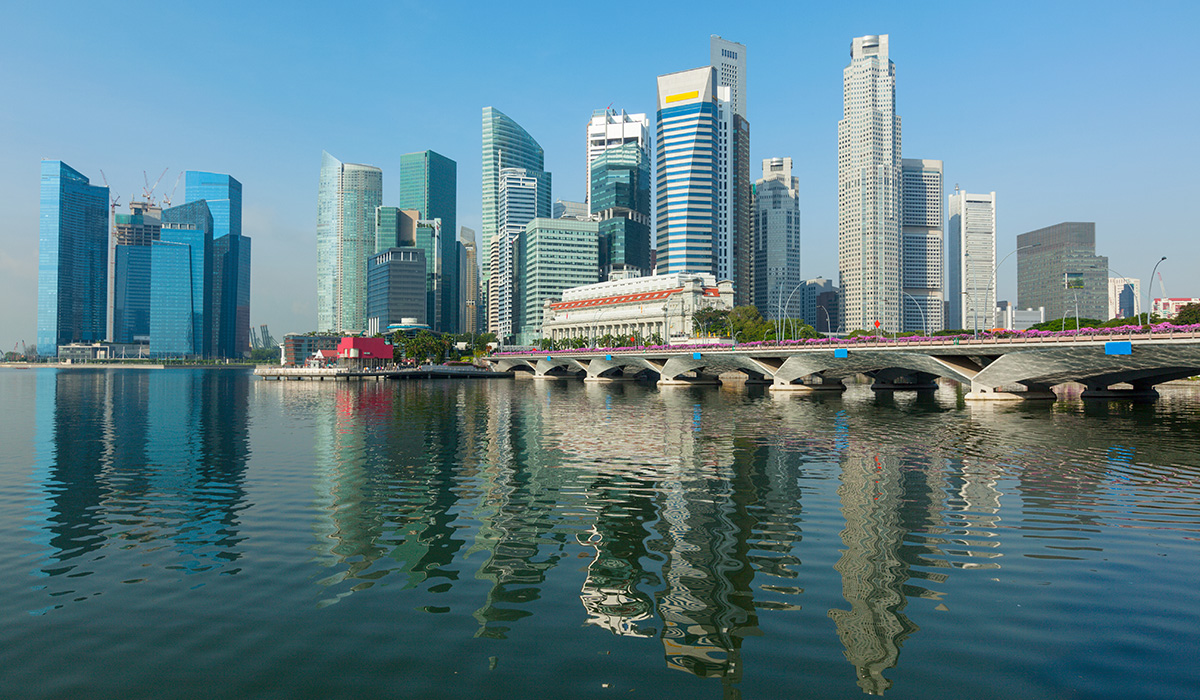













Singapore is widely regarded as a competitive jurisdiction for business, including a competitive corporate income tax regime (e.g., the prevailing headline corporate income tax rate is 17% for companies), alongside an extensive treaty network and a strong regulatory environment.
Companies all around the world are eager to conduct business in Singapore. However, for entities that are not entirely convinced of the business “haven” description of Singapore and prefer to take as low a risk as possible when starting in a new business environment or region, they might consider the option of a Singapore Representative Office Registration.
Singapore has proved many times to be one of the best places to do trade and business activities in the world. Besides being regarded as one of the 4 Asian tigers, Singapore also has one of the most open and dynamic economic environments in the world.
In addition to having one of the largest foreign reserves in the world, Singapore has a triple-A rating by business rating consultant agencies, and it also boasts a corrupt-free business system with little influence from the government; it took 11th place in the Human Development Index and has the second highest GDP per Capita.
In this article, we will explain what a representative office is and why companies establish it, the process of setting up a representative office and the documents required, how the authorization and renewal procedure is carried out, and finally, how Premia TNC can aid you in issues regarding the representative office in Singapore.
What Is a Singapore Representative Office?
A representative office is a temporary place of work set up by a foreign company in Singapore in order to assess and evaluate the business atmosphere of the country.
Some companies, when establishing foreign branches or a subsidiary in a totally new environment, might want to experience firsthand how the market of that region works while taking as little risk as possible before pulling in resources for an all-out venture.
These include aspects such as consumer behavior and habits, government business policies and laws, profitability of the enterprise, and the tax system.
A representative office that a foreign company wants to establish in Singapore would have to take the name of that same company, which is usually referred to as the “parent” company of the representative office.
A representative office can perform some amount of business activities, such as information gathering in Singapore. However, these actions are quite limited.
The representative office is a good option for companies who are still skeptical about the business process in Singapore and how to conduct more research with as little cost as possible. However, there are certain rules and guidelines that govern how the representative office functions.

A Singapore representative office is intended to conduct market research and feasibility studies and other non-commercial / non-revenue-generating exploratory activities (i.e., it is not allowed to conduct trading or business activities that yield profit). Examples typically include:
- Collect, and review data and information on the business environment, prospective customers, and likely competition.
- Partake in trade shows and product exhibitions.
- Establish business interactions and respond to product queries.
- Simulate mock business settings and gather information on how to establish a company in Singapore.
Likewise, a representative office must not engage in commercial / revenue-generating activities. Prohibited activities generally include:
- Organize actual trade and profit-making ventures.
- Establish and sign business contracts and proposals on behalf of its parent company.
- Rent business properties such as warehouses.
- Advertising or engaging in promotional and marketing activities.
- Distribute products with the aim of making a profit.
- Issue receipts, invoices, and tax statements.
- Acquiring industrial raw materials for production.
- Negotiating and executing business deals in Singapore on behalf of its parent company.
Since a representative office cannot engage in any profit-making venture in Singapore, it is not required to pay any tax.
To expand on this, a representative office is not supposed to generate income in Singapore. In practice, this generally means there should be no corporate income tax exposure because there is no taxable income, but the RO must ensure it does not accidentally cross into “carrying on business” or revenue-generating activity (which can create regulatory and tax consequences). The RO should still expect normal administrative obligations (e.g., employment-related compliance if it hires staff).
Who regulates Representative Offices in Singapore (and which authority you apply to)
A common source of confusion is “who approves” a Representative Office (RO). In Singapore, a RO is generally administered under Enterprise Singapore’s RO scheme, and the application is submitted online via the Government’s business licensing / application pathways referenced by Enterprise Singapore. Approved ROs are typically granted a validity period of one year, and extensions are assessed case-by-case, up to a maximum total presence of three years. ROs that wish to continue in Singapore after that generally need to set up a longer-term structure (for example, registering with ACRA).
It is recommended for some regulated sectors to approach the relevant sector regulator for RO arrangements and guidance. For example, the banking/finance/financial exchanges/insurance sector entities may approach the Monetary Authority of Singapore (MAS), and foreign law practices may approach the Ministry of Law (MinLaw). This matters because the “RO” concept and permissible activities can differ by sector, and regulated entities should confirm the appropriate route before proceeding.
Practical takeaway: before preparing documents, confirm (1) your sector and (2) the correct approving body (Enterprise Singapore for ROs from the manufacturing, international trading, wholesale and trade-related business sectors; MAS/MinLaw for the noted sectors), so you don’t waste time on the wrong application pathway.
Process and Documents needed for Singapore Representative Office Registration
Setting up a representative office in Singapore is a straightforward process, provided the parent company has fulfilled all the requirements including the following:
- The parent company that wants to establish the representative office must have at least three years of existence.
- The sales turnover of the parent company must be at least US$250,000.
- The number of personnel at the representative office must not exceed 5.
The application process also involves certain operational prerequisites, such as having a Corppass account and a nominated Corppass admin with a valid NRIC/FIN. If the foreign entity does not have staff holding an NRIC/FIN, a local third-party proxy may be used instead.
After these requirements have been met, some documentation would have to be submitted to the Enterprise Singapore (ESG); these documents are:
- Certificate of legal incorporation and registration certificate of the parent company.
- Latest financial statements and audit reports of the parent company.
- A legal undertaking stating that the representative office would follow all the guidelines and laws governing representative offices in Singapore.
- A fee S$200 per year (non-refundable for unsuccessful or withdrawn applications.
After submission of the documents, the registration process is conducted online, after which Enterprise Singapore, or the relevant authority, reviews the application.
Processing times can vary depending on application completeness and any follow-up queries from the approving authority. In some cases, the reviewing authority may request additional documents, which can lengthen the overall processing time.
Authorization and Renewal Information for a Singapore Representative Office
After the registration of the representative office has been completed, the office is allowed to perform the activities within the scope of the law and guidelines.
For example, the representative office and the parent company must have the same name, the representative office must clearly state in fliers and descriptions that it is a “Representative office in Singapore.”
In addition, the RO should ensure its name and representations do not mislead third parties into thinking it is a locally incorporated company or that it is authorised to conduct commercial business in Singapore.
The initial registration of the representative office is only valid for one year, after which they must submit a new application if they want to continue operations in Singapore. However, extensions are granted on a case-by-case basis, subject to approval, up to a maximum period of three years.
This includes resubmission of the necessary documents during the application. A representative office can exist in Singapore for a maximum of three years; after this period, the usual next step is to register a longer-term structure such as a local subsidiary company or a foreign company branch with ACRA if the business intends to continue operating in Singapore.

Post-approval compliance checklist (often missed)
Even though an RO is not a separate legal entity, it can still create real compliance exposure if it operates like a business. After approval, companies typically should put controls in place to ensure the RO remains within permitted scope:
- Activity controls: Keep clear internal guidelines that the RO must only conduct market research/feasibility and liaison-type activities. Train staff on what they cannot do (no pricing commitments, no signing contracts for Singapore deals, no invoicing/receipts, no taking orders).
- Employment and immigration: If the RO hires local employees, it must comply with Singapore employment laws and related statutory obligations. If it appoints a foreign “chief representative” or brings foreign staff to work in Singapore, it must comply with the Ministry of Manpower’s work pass requirements and conditions. (Work pass eligibility and documentary expectations can change, so employers should check the latest official requirements before applying.)
- Document retention and renewals: Maintain a compliance file with (i) the Letter of Approval, (ii) the RO’s approved scope of activities, (iii) updated parent-company audited accounts, and (iv) any extension correspondence. Start extension planning early to avoid lapses.
- Regulated communications: Marketing materials, name cards, and email signatures should clearly identify the entity as a “Representative Office” and avoid implying it is a Singapore-incorporated company. This reduces misrepresentation and contracting risk.
- Tax risk management: While an RO is not meant to generate income, it should still avoid activities that could be interpreted as carrying on business in Singapore. Where the business model changes (e.g., you want to start selling, signing Singapore contracts, or charging customers), treat that as a trigger to register a subsidiary/branch instead and obtain proper tax/regulatory advice.
Streamlining Corporate Bank Account Opening Procedures
After successfully registering, a Singapore representative office has the flexibility to open a bank account with a wide array of international and local banks within the country.
However, account opening procedures, onboarding timelines and requirements vary significantly by bank and by the customer’s risk profile. Many banks may also require additional due diligence (KYC/AML) information, and in some cases may require in-person verification or certified documents.
Typically, banks require a number of key documents to open an account. Primarily, these consist of a completed and signed account opening application form, a photocopy of the Letter of Approval from Enterprise Singapore, and a board resolution authorizing the account opening and designating the signatories.
Additionally, a photocopy of the parent company’s Certificate of Incorporation, Memorandum & Articles of Association, Register of Directors (or equivalent), and proof of beneficial ownership, such as the Register of Shareholders, Certificate of Incumbency, or a Declaration of Beneficial Ownership, along with the identification card or passport of the beneficial owner, are needed. Identification cards or passport copies of directors, authorized signatories, and chief representatives are also required.
Distinction Between Representative Office, Branch, and Subsidiary Company Structures in Singapore
Representative Office
A representative office in Singapore is a temporary administrative arrangement lacking legal status. It is primarily for market research and liaison activities, and it cannot engage in trading or business activities which yield a profit. Liabilities incurred by a representative office extend to its parent company. It requires extension consideration and may be approved for up to a maximum of 3 years in total, subject to case-by-case approval.
Branch Office
A branch office in Singapore functions as an extension of its parent company without constituting a separate legal entity. Liabilities incurred by the branch extend to the parent company.
Taxation is at the prevailing corporate income tax rate of 17% on chargeable income (this rate applies to both local and foreign companies). Access to exemptions/incentives depends on the specific scheme conditions and whether the company qualifies under those conditions.
For registration and ongoing statutory matters, ACRA states that a foreign company branch must have a locally resident authorised representative and comply with statutory and disclosure requirements under the Companies Act (including annual filing requirements for foreign companies).
Subsidiary Company
A subsidiary company in Singapore is a distinct legal entity from its parent company, allowing for limited liability and local tax benefits. Liabilities are confined to the subsidiary, shielding the parent company.
Taxation is at the prevailing corporate income tax rate of 17% on chargeable income. Eligibility for tax exemptions or incentives depends on the scheme conditions (e.g., certain exemptions apply only to qualifying companies).
Once established, a subsidiary remains registered indefinitely until a decision to close it is made, providing autonomy and legal protection for the parent company’s operations in Singapore.
Converting from a Representative Office to a Local Company
To transition from a representative office to a local company in Singapore, companies must register either a branch office or subsidiary with ACRA.
ACRA’s current guidance for registering a foreign company branch indicates you must engage a corporate service provider (CSP) to register for you, and the branch must have a locally resident authorised representative. For the registration of local subsidiary companies, foreigners without Singpass, or foreign companies without any staff holding a Singpass account, must engage a corporate service provider to submit the company name and incorporation applications on their behalf.
A corporate service provider like Premia TNC can facilitate document preparation and filing procedures with ACRA, ensuring compliance with Singaporean regulations.
How Premia TNC can Help?
If you want to establish a representative office in Singapore, you can consider contacting Premia TNC to set up your representative office.
We are one of the top business consulting and tax accounting firm, and all the necessary registration processes, documentation and information gathering would be conducted to ensure the success of your representative office.
Contact us to get a FREE consultation on your Singapore Representative Office queries today!
Frequently Asked Questions
Can a representative office sell products in Singapore?
No. A representative office cannot conduct any trade activities in Singapore.
Would a representative office pay tax?
Generally, no, because a representative office is not permitted to carry out profit-making activities and should not generate taxable income in Singapore. However, if its activities stray into revenue-generating business or if the office earns Singapore-sourced income, tax obligations may arise under Singapore’s general corporate tax rules. In addition, a representative office that fails to comply with the stipulated Terms and Conditions, including engaging in revenue-generating activities, may be subject to de-registration.
How long is a representative office valid for?
The representative office is valid for one year from its commencement date, and any extension is assessed case-by-case, up to a maximum of three years in total.