












Key Takeaways
- There is generally no fixed statutory requirement under the Singapore Companies Act for every company to hold a set number of board meetings each year; the practical rules usually come from the company’s constitution.
- Under the Model Constitution, any director may summon a directors’ meeting, and the secretary must do so if requested by a director.
- Under the Model Constitution, the quorum may be fixed by the directors, and unless fixed otherwise, it is 2 directors. This is not a universal rule for every company unless the constitution says so.
- Companies must keep minutes of directors’ meetings and written resolutions in accordance with section 188 of the Companies Act, with non-compliance exposing the company and defaulting officers to fines and default penalties.
- Shareholders do not have an automatic right to attend board meetings unless the constitution, board, or invitation process allows it. Their legal participation rights usually attach to shareholder meetings instead.
In Singapore, every successful organization requires planning and proper structure to operate. This includes knowing the key business processes, such as the Singapore board meeting requirements.
Additionally, such an organization must understand the regulatory landscape . This means they must understand the business laws and relevant processes of their location.
Board meetings are a serious affair. They are a core part of a company’s internal decision-making process and typically involve the directors, with the company secretary often handling notices, agendas, and minutes. Shareholders do not automatically attend unless invited or otherwise permitted under the company’s constitution.
If you’re an executive member of a business or organization looking to carry out or have already undergone a Singapore incorporation, you’ll find this article handy. Read on to learn all about Singapore board meeting requirements and the executive structures.
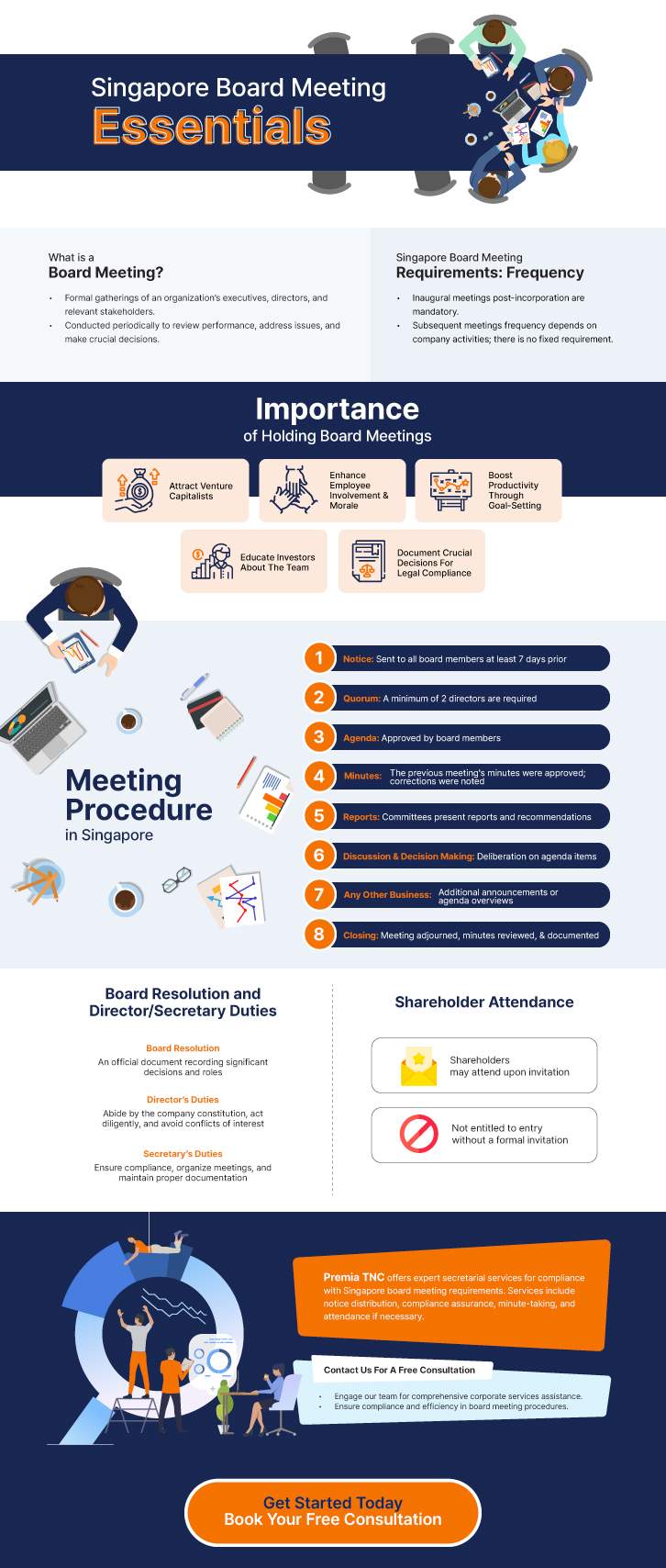
What is a Board Meeting?
A board meeting is a meeting of the company’s directors to discuss and decide matters relating to the management of the company. In Singapore, the detailed rules for directors’ meetings are usually found in the company’s constitution rather than in a single section of the Companies Act. Even so, the Act still matters because it imposes duties on directors and requires minutes of proceedings to be kept properly.
Board meetings are formal meetings of a company’s directors. Depending on the company’s needs, the company secretary, management team, or invited advisers may also attend, but the directors remain the persons responsible for board decisions.
The meetings are held at specific intervals in a calendar year, with debates and deep discussions to review performances, address arising issues, consider company policy implications and handle legal affairs.
Board meetings are usually presided over by the chairperson if one has been appointed. Under the Model Constitution, directors may elect a chairman for their meetings, and if no chairman is available, the directors present may choose one of their number to chair that meeting.
The meeting’s minutes must be documented and kept as part of the company’s records. Under section 188 of the Companies Act, minutes of proceedings of directors’ meetings and minutes of written directors’ resolutions must be kept, and default can result in a fine of up to S$2,000 plus a default penalty.
In practice, board meetings are important for private companies as well as larger corporations, because they create an evidence trail for approvals, oversight, conflict management, banking mandates, financing decisions, and other significant corporate actions. This is especially useful when the company later needs to show how a decision was properly authorised.

Singapore Board Meeting Requirements: Frequency of Mandatory Meetings for Directors
Following incorporation, many companies hold an inaugural board meeting as a matter of good governance, for example to confirm the appointment of officers, approve banking matters, adopt registers, or authorise initial operational steps. However, there is generally no universal statutory rule in Singapore requiring every private company to hold a fixed number of board meetings per year. The frequency of directors’ meetings is usually governed by the company’s constitution and practical business needs. Under the Model Constitution, the directors may meet and regulate their meetings as they think fit.
Why You Should Hold Board Meetings
Board meetings are an indispensable aspect of an organization’s strategic processes. Here are a few reasons why board meetings may be held.
1. To attract venture capitalists
VCs (venture capitalists) are everywhere in the business world, always looking for serious, promising organizations to invest in.
If your company already has dealings with venture capitalists or angel investors, your regular board meetings will make them more likely to invest in your next funding round. VCs are never obliged to fund your organization after the seed round consistently.
One of the best ways to keep them interested is by giving them monthly investor updates, and there’s no better way to do this than to hold regular board meetings. Once a month or once in 6 weeks is a good idea.
2. To make your employees feel valued and heard
Board meetings don’t have to be boring affairs all the time. If you’re serious about making your senior employees feel valued and included in the journey to the top, board meetings are a great way to achieve this.
Your employees will appreciate your efforts at being inclusive by inviting the heads of key departments like sales, logistics, customer success, engineering, and product management, to join your board meetings.
3. To boost healthy competition and business productivity
Another reason you should hold board meetings is to encourage your management team and senior employees to hit targets and achieve deliverables on time.
Once everyone on the board has set targets on an annual, monthly, or quarterly basis, your board meetings can form the basis for encouraging them on their duties.
You can then track their goals at each meeting. With the right balance of prodding and people management, your board meetings can be a major source of inspiration and productivity for the organization.
In the long run, such board meetings will yield productivity and inspire your heads of department to give their all. In a nutshell, board meetings are great for team bonding and employee morale.
4. To educate your investors about your team
Board meetings are an excellent avenue for onboard and potential investors to learn about your organization and your team. Given your dealings, it can be assumed that your investors already know everything about you and your organization.
But how do they learn about your team members?
At a board meeting, you can give your leads the floor to express their ideas and impress your investors too! Your investors can always discuss one-on-one with you. However, your board meetings can be an opportunity for your executives to show their worth to your investors.
5. For a written document
One of the major results of board meetings is the creation of formal corporate records that help support important company decisions and corporate governance. Proper minutes and resolutions can be critical when dealing with banks, auditors, investors, regulators, and future disputes about whether a decision was duly authorised. and back up business policy.
These written records, official as they are, can be the difference between legal compliance and costly lawsuits further down the line for you and your organization.
Singapore Board Meeting Procedure
There are certain rules and guidelines for how a board meeting should be held. In Singapore, directors’ meetings are generally governed by the company’s constitution, although the Companies Act still imposes duties on directors and record-keeping obligations. The commonly used Model Constitution is often a useful reference point, but your company should always check its own constitution because its wording may differ.
1. Send a notice to all board members
Under the Model Constitution, any director may summon a meeting of the directors, and the secretary must summon one if requested by a director. The constitution may set out how notice is given, to whom it is sent, and how much notice is appropriate. A fixed seven-day notice period is not a universal rule under Singapore law for all companies.
As a matter of good practice, the notice should include the date, time, place or virtual meeting details, agenda, and papers required for decision-making. A board meeting may later be challenged if a director who was entitled to notice was not properly informed under the constitution or the board’s agreed procedures.
2. Determine the quorum
The quorum refers to the minimum number of directors that must be present for a board meeting to be held when not all members are available.
This is important because the quorum can vote on decisions on behalf of the entire board, and there would be no delay in decision-making or taking action when necessary.
There is not one universal statutory quorum for every Singapore company. Under the Model Constitution, the quorum may be fixed by the directors, and unless they fix another number, the default quorum is 2. Companies should therefore check their own constitution before assuming that 2 directors are always required.
3. Call the meeting to order
After a notice has been sent out and the board members have convened for the board meeting, the board chairman opens the meeting by calling the meeting to order. This involves making several opening remarks, such as welcoming the board members.
4. Approve the meeting agenda
After calling the meeting to order, the board chairman requests for the agenda of the meeting to be approved by the other board members.
Here, the board members can request additions or corrections to be made to the meeting agenda. Where there is a conflict of interest with regards to approving the agenda, the members may have to take a vote.
5. Approve previous meeting minutes
Keeping legal records of board meetings is mandatory. Under section 188 of the Companies Act, minutes of proceedings of directors’ meetings must be kept, and non-compliance can expose the company and every defaulting officer to a fine not exceeding S$2,000 plus a default penalty.
The previous minutes are commonly circulated before the next meeting for review, amendment, and confirmation. Under the Model Constitution, minutes are signed by the chairman of the meeting at which the proceedings were held or by the chairman of the next succeeding meeting.
6. Hearing of reports
The next step in the board meeting is hearing reports from different committees on the board, such as the financial report. Recommendations can also be made by the committees at this point and should be adopted by the reporting member.
The report or recommendation is filed with no action if it is not adopted.
7. Discussion and decision making
The board can then discuss old business, new business, and resolutions. Under the Model Constitution, questions arising at a directors’ meeting are decided by a majority of votes, and in the case of equality of votes, the chairman has a second or casting vote, unless the company’s own constitution provides otherwise.
8. Any other business
Here, the board members can introduce any other business that doesn’t necessarily need discussions or vote-taking. It could be announcements or an overview of the next board meeting agenda.
9. Closing the meeting
The board chairman closes the meeting by first thanking everyone present and proceeds to adjourn the meeting. After this, the board chairman and the executive officer review various aspects of the meeting before the secretary writes the official minutes.
Practical compliance points directors should not overlook
- Check the constitution before every meeting for rules on notice, quorum, chairman, written resolutions, and conflicts.
- Ensure any interested director makes the required disclosure as soon as practicable.
- Keep supporting board papers together with the minutes so the approval trail is clear.
- Where the company has one director, check whether the matter can be handled by a sole-director written record instead of a physical meeting.
- Keep signed minutes and written resolutions in the company’s minute books and records in Singapore as required.
Singapore Board Resolution
A board resolution is a formal record of a decision made by the directors. It does not merely record the “roles” of officers; instead, it usually records that the directors considered and approved a matter, such as opening a bank account, appointing authorised signatories, approving a contract, allotting shares, appointing officers, or authorising filings.
In Singapore, a board resolution may be passed either at a properly convened directors’ meeting or, where the constitution allows, by written resolution. Under the Model Constitution, a written resolution signed by all directors entitled to receive notice of the meeting is as valid and effectual as if passed at a duly convened meeting. Where the company has only one director, that director may pass a resolution by recording it and signing the record.
Section 157A of the Companies Act states, in substance, that the business of a company is managed by or under the direction or supervision of the directors, subject to the Act and the company’s constitution. This is why board resolutions are a central governance tool even though the Act does not list every situation that requires one.
Company Director’s Duties
The duties of a company director include:
- Acting honestly and using reasonable diligence in the discharge of the duties of office.
- Acting in accordance with the Companies Act and the company’s constitution.
- Exercising independent judgment in the interests of the company.
- Disclosing interests in transactions or proposed transactions with the company as soon as practicable after the relevant facts come to the director’s knowledge.
- Avoiding improper conflicts and not voting where the constitution or applicable rules require abstention. Under the Model Constitution, an interested director must not vote on the relevant transaction and that vote must not be counted.
- Ensuring proper record-keeping, filings, and compliance oversight. ACRA also states that directors are responsible for accurate and timely record keeping and for complying with corporate filings and disclosures.
Company Secretary’s Duties
The duties of the company secretary include:
- Maintaining and updating the company’s registers and minute books.
- Administering, attending, and preparing minutes of meetings of directors and shareholders.
- Assisting with notices, agendas, meeting logistics, and the company’s corporate records.
- Keeping directors aware of annual return deadlines and other ACRA filing obligations.
- Updating directors and shareholders on relevant changes in corporate regulations.
Companies must appoint a company secretary within 6 months from incorporation. The secretary must be a natural person ordinarily resident in Singapore, and the sole director of a company cannot also act as its company secretary.
Shareholder Attendance
Shareholders do not have a general legal right to attend board meetings simply because they are shareholders. Board meetings are meetings of directors, while shareholders’ formal participation rights ordinarily apply at shareholder meetings such as annual general meetings or extraordinary general meetings. A shareholder may attend a board meeting only if invited or if the constitution provides for that participation.
Common mistakes companies make with board meetings
Many compliance issues do not come from failing to hold a meeting at all, but from poor execution. Common examples include using the wrong quorum, failing to give notice to a director entitled to receive it, forgetting to document a conflict disclosure, relying on an unsigned written resolution, and keeping minutes that are too vague to show what was actually approved. Another practical risk is copying a “standard” process from another company without checking the company’s own constitution. In Singapore, that can be a real problem because the constitution often determines the mechanics of directors’ meetings. A company that wants its board approvals to withstand scrutiny from banks, investors, auditors, counterparties, or regulators should keep a clear paper trail: notice, agenda, attendance, declarations of interest, the wording of resolutions, and signed minutes or written resolutions.
Let Us Help You – Our Professional Company Secretarial Services
Company secretaries in Singapore are tasked with providing administrative and compliance support to the company and its directors. ACRA’s guidance includes maintaining minutes books and registers, administering meetings of directors and shareholders, and keeping directors aware of filing deadlines and relevant regulatory changes.
At Premia TNC, we offer professional company secretarial services that can make keeping up with board meeting minutes and agendas easier. Our in-house experts are highly accessible and competent, providing professional secretarial services, including and not limited to:
- Assisting on sending out the notice of meetings
- Helping maintain minutes books and statutory records properly
- Ensuring that the compliance rules are met
- Making proper notes and records of meetings
- Attending meetings, if necessary to ensure compliance with Singapore board meeting requirements
Interested in engaging our professional team of experts? Contact us to get a FREE consultation on all your corporate services’ needs.
Frequently Asked Questions
1. What is the role of the board?
The board’s main role is to manage or supervise the management of the company’s business, subject to the Companies Act and the company’s constitution. In practical terms, this means approving significant business decisions, overseeing governance, and ensuring the company is properly directed.
2. What are the Singapore board meeting requirements for the meeting duration?
There is no universal time frame for a board meeting as the type of company, and the size of the company and the board will play a major role in determining the duration of the meeting.
However, board meetings should be kept short with emphasis on concision. A well-detailed meeting agenda makes for better time management during meetings.
3. What are the Singapore board meeting requirements for the attendance of company staff?
Board meetings are meant for directors, but it is common for senior staff or advisers to attend for specific agenda items such as finance, legal, operations, or budgeting. Unless they are also directors, they generally do not vote on board decisions.
It is also important to note that these staff members do not participate in the voting or decision-making process of the board and do not interfere unless they are requested to.
4. How can a tie vote be avoided during a board voting session?
The first step is to check the company’s constitution. Under the Model Constitution, in the case of an equality of votes, the chairman has a second or casting vote. Companies can also reduce deadlocks by setting clear agendas, circulating papers early, and ensuring conflicts are identified before voting.
5. Is a board retreat a good idea?
Some issues are very delicate and would better be discussed outside the four walls of an official office. A board retreat is a good idea as it is a great way to ease the tension among board members and strengthen the relationship between board members.
6. What are the Singapore board meeting requirements for sending meeting notices to directors?
The exact notice requirements depend primarily on the company’s constitution. Under the Model Constitution, any director may summon a meeting and the secretary must do so on a director’s requisition, but the legislation does not impose one universal notice period for all board meetings. As good practice, the notice should include the meeting’s time, date, venue or virtual details, and agenda.
7. What are the Singapore board meeting requirements for the minutes-taking during a meeting?
Minutes are a legal record of the board meeting and should accurately record attendance, declarations of interest, resolutions, and key proceedings. Under section 188 of the Companies Act, minutes of proceedings of directors’ meetings must be kept, and under the Model Constitution they are signed by the chairman of that meeting or the chairman of the next succeeding meeting.
Keeping minutes of a board meeting is a legal requirement in the Companies Act under Section 188.
8. How are conflicts handled in board meetings?
A director who is interested in a transaction or proposed transaction with the company must disclose that interest as soon as practicable. Under the Model Constitution, an interested director must not vote on that matter and the vote must not be counted. The disclosure and abstention should also be recorded in the minutes.
9. Is it in the board's power to approve all matters concerning the company?
Not all matters. Directors generally manage the business of the company, but some matters are reserved to shareholders under the Companies Act or the constitution, such as certain shareholder approvals, constitutional changes, or other matters requiring members’ resolutions.